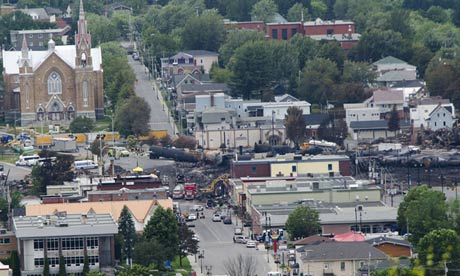
 Five days after a train carrying crude oil derailed and exploded in Lac-Mégantic, Quebec, the rural town resembles a scene of desolation. Its downtown is a charred sacrifice zone. 50 people are likely dead, making the train's toll one of the worst disasters in recent Canadian history.
In the explosion's aftermath, politicians and media pundits have wagged their finger about the indecency of "politicising" the event, of grappling with deeper explanations. We can mourn, but not scrutinise. In April, prime minister Stephen Harper even coined an awkward expression – "committing sociology" – to deride the search for root causes about horrifying events, in the wake of an unrelated, alleged bombing attempt.
But to simply call the Lac-Mégantic explosion a "tragedy" and to stop there, is to make it seem like an accident that occurred solely because of human error or technical oversight. It risks missing how we might assign broader culpability. And we owe it to the people who died to understand the reasons why such a disaster occurred, and how it might be prevented in the future.
So here's my bit of unwelcome sociology: the explosion in Lac-Mégantic is not merely a tragedy. It is a corporate crime scene.
 New York City’s top watchdog agency has hired a team of lawyers to investigate exactly what...
 Earth cooked to its hottest month on record in August, blowing far past a key climate...