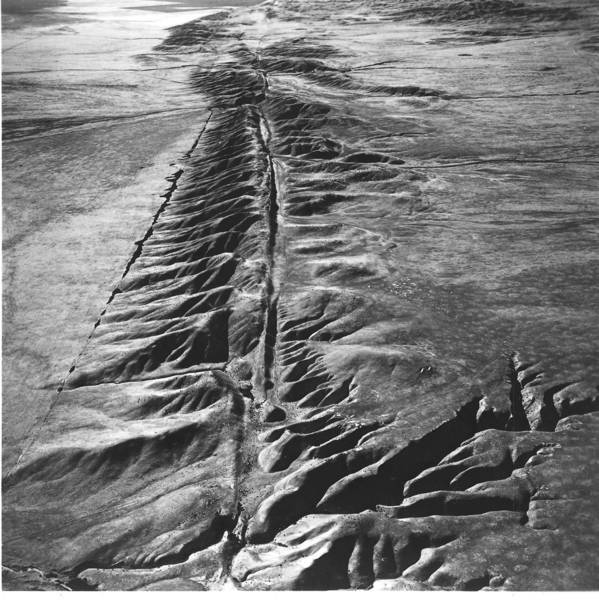
 For decades, scientists have assumed the central portion of California's San Andreas fault acts as a barrier that prevents a big quake in the southern part of the state from spreading to the north, and vice versa. As a result, a mega-quake that could be felt from San Diego to San Francisco was widely considered impossible.
But that key fault segment might not serve as a barrier in all cases, researchers wrote Wednesday in the online edition of the journal Nature.
Using a combination of laboratory measurements and computer simulations, the two scientists showed how so-called creeping segments in a fault — long thought to be benign because they slip slowly and steadily along as tectonic plates shift — might behave like locked segments, which build up stress over time and then rupture.
Such a snap caused the 9.0-magnitude Tohoku-Oki earthquake that hit Japan in 2011, triggering a tsunami, killing nearly 16,000 people and destroying the Fukushima Daiichi nuclear power plant. Forecasters had not believed such a large quake was possible there.
 Down a short gravel track in a largely nondescript corner of Louisiana sits a gas processing...
 Netia McCray recalls how excited she was to join the federal advisory committee on long COVID...
 A 10,000 year-old tooth in remarkable condition from an ancient Pacific mastodon, a large mammal that...
 The universe is a strange place — filled with exploding stars, ancient galaxies, and unseen worlds....