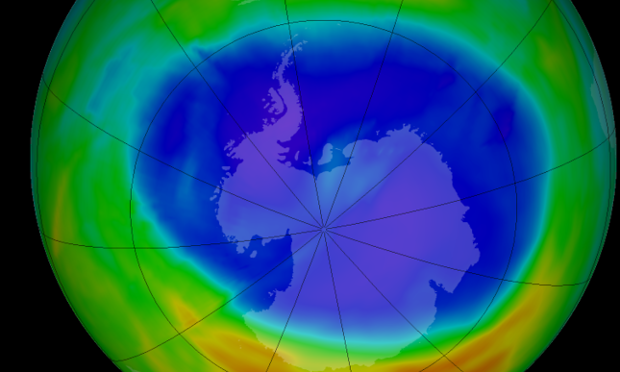
 The Antarctic ozone hole, which was expected to reduce in size swiftly when manmade chlorine emissions were outlawed 27 years ago, is stubbornly remaining the size of North America, new data from Nasa suggests.
The hole in the thin layer of gas, which helps shield life on Earth from potentially harmful ultraviolet solar radiation that can cause skin cancers, grows and contracts throughout the year but reached its maximum extent on 9 September when monitors at the south pole showed it to cover 24.1m square km (9.3m sq miles). This is about 9% below the record maximum in 2000 but almost the same as in 2010, 2012 and 2013.
But scientists remain unsure why the hole has not reduced more since the Montreal Protocol agreement was signed by countries in 1987.
This global treaty is considered one of the world’s most successful, having been pushed through in record time. It bans the use of ozone-depleting chlorofluorocarbons (CFCs), substances that were widely-used in household and industrial products such as refrigerators, spray cans, insulation foam and fire suppressants.
 New York City’s top watchdog agency has hired a team of lawyers to investigate exactly what...
 Earth cooked to its hottest month on record in August, blowing far past a key climate...