

 A case filed before an African judicial body could open a new front in efforts by human rights groups to hold the CIA and its partners accountable for what they allege was the torture of innocent victims in secret "black site" prisons around the world.
The case involves Mohammed al-Asad, who said he was arrested in late 2003 at his home in Tanzania, blindfolded and flown to a secret prison in Djibouti. He said he was subjected to two weeks of torture and inhuman treatment in a clandestine CIA rendition and detentions program designed to nab suspected terrorists.
African commission asked to take case challenging CIA rendition program
BP fund lawyer to refuse 100,000 Gulf spill disaster claims
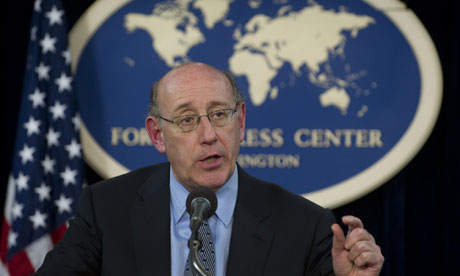 Upwards of 100,000 claims arising from the BP oil disaster in the Gulf of Mexico may never be paid, the beleaguered administrator of the oil company's compensation fund has acknowledged.
A defensive Ken Feinberg, under fire from the Obama administration, Gulf leaders and local business for the slow pace of payouts for losses due to the BP spill, said the vast majority of the 130,000 unsettled claims did not have adequate documentation.
JOHN PILGER : BEHIND THE ARAB REVOLT IS A WORD WE DARE NOT SPEAK
 Fascism is a difficult word, because it comes with an iconography that touches the Nazi nerve and is abused as propaganda against America’s official enemies and to promote the West’s foreign adventures with a moral vocabulary written in the struggle against Hitler. And yet fascism and imperialism are twins.
As the Washington historian William Blum has documented, since 1945, the US has destroyed or subverted more than 50 governments, many of them democracies, and used mass murderers like Suharto, Mobutu, and Pinochet to dominate by proxy. In the Middle East, every dictatorship and pseudo-monarchy has been sustained by America. In “Operation Cyclone,” the CIA and MI6 secretly fostered and bank-rolled Islamic extremism. The object was to smash or deter nationalism and democracy. The victims of this Western state terrorism have been mostly Muslims. The courageous people gunned down last week in Bahrain and Libya, the latter a “priority UK market,” according to Britain’s official arms “procurers,” join those children blown to bits in Gaza by the latest American F-16 aircraft.
Libya: African mercenaries 'immune from prosecution for war crimes'
 African mercenaries hired by the Gaddafi regime to kill Libyan protesters would be immune from prosecution for war crimes due to a clause in this weekend's UN resolution that was demanded by the United States.
This means that mercenaries from countries such as Algeria, Ethiopia and Tunisia – which have all been named by rebel Libyan diplomats to the UN as being among the countries involved – would escape prosecution even if they were captured, because their nations are not members of the court.
Army reviewing complaints from Ore. National Guard about their heathcare
 The Army views complaints Oregon National Guard soldiers raised about the care they received at Madigan Army Medical Center last year as signs of systemic problems with how infantrymen are treated when they return from combat. But Army officials refuse to detail how they are responding to those concerns.
The Army finished three reviews of the Oregon Guard’s complaints more than four months ago. It won’t release the full reports for at least another month, pending a final review of one of the documents, a spokeswoman for the Army Western Regional Medical Command said Friday.
We are not the enemy: An Arab Jew argues for bridging East and West with peace and justice for all
 If I were in a position to deliver a message to the people of the Middle East, including Israelis, I would proudly declare myself an Arab Jew and remind everyone that Jews have been an integral part of the Middle East mosaic for millennia.
We are not the enemy, and often we speak the same languages - Arabic, Farsi, Turkish etc. Our ancestors have lived in Syria, Iraq, Egypt, Iran, Turkey and even Afghanistan for hundreds, sometimes thousands, of years.
We're all aliens... how humans began life in outer space
 As scientific mysteries go, this is the big one. How did life on Earth begin? Not how did life evolve, but how did it start in the first place? What was the initial spark that lit the fire of evolution?
Charles Darwin solved the mystery of life's wondrous diversity with his theory of natural selection. But even he was flummoxed by the ultimate mystery of mysteries: what led to the origin of life itself?
GOP spending plan would cost 700,000 jobs, new report says
 A Republican plan to sharply cut federal spending this year would destroy 700,000 jobs through 2012, according to an independent economic analysis set for release Monday.
The report, by Moody's Analytics chief economist Mark Zandi, offers fresh ammunition to Democrats seeking block the Republican plan, which would terminate dozens of programs and slash federal appropriations by $61 billion over the next seven months.
X-Rays and Unshielded Infants
 With technologists in many states lightly regulated, or not at all, their own professional group is calling for greater oversight and standards.
For 12 years, the American Society of Radiologic Technologists has lobbied Congress to pass a bill that would establish minimum educational and certification requirements, not only for technologists, but also for medical physicists and people in 10 other occupations in medical imaging and radiation therapy.
Page 659 of 1167