Environmental News Archive




Until now, most discussion of climate change has been about what scientific evidence shows is likely to happen between now and 2100. However, scientific research shows that the carbon dioxide gas released from burning fossil fuels lasts in the atmosphere much longer than mere decades.
David Archer, a leading climate researcher who teaches at the University of Chicago, has written a new book that looks at carbon dioxide's "long tail" and what it means for changes on Earth in the future.
Carbon dioxide emissions could last millenniums, expert says
Indian experts find bacteria to beat global heat
In a major breakthrough that could help in the fight against global warming, a team of five Indian scientists from four institutes of the country have discovered a naturally occurring bacteria which converts carbon dioxide (CO2) into a compound found in limestone and chalk.
When used as an enzyme — biomolecules that speed up a chemical reaction — the bacteria has been found to transform CO2 into calcium carbonate (CaCO3), which can fetch minerals f economic value, said Dr Anjana Sharma from the biosciences department of RD University, Jabalpur, who was part of the Rs 98.6 lakh project sponsored by the department of biotechnology (DBT) under the Union science and technology ministry.
TVNL Comment: The problem with too much CO2 is that we have been poisoning the oceans. It is ocean plant life that consume CO2 and provide us with oxygen. If we don't stop killing the ocean we will not have enough oxygen to survive. That is the REAL problem.
The tropics on fire: scientist's grim vision of global warming
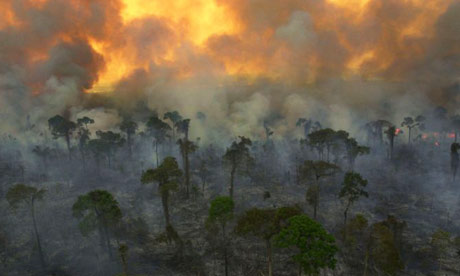 Soaring greenhouse gas emissions, driven by a surge in coal use in countries such as China and India, are threatening temperature rises that will turn damp and humid forests into parched tinderboxes, said Dr Chris Field, co-chair of the UN's Nobel prize-winning Intergovernmental Panel on Climate Change (IPCC).
Climate change even worse than predicted: expert
 It seems the dire warnings about the oncoming devastation wrought by global warming were not dire enough, a top climate scientist warned Saturday.
It has been just over a year since the Nobel-winning Intergovernmental Panel on Climate Change (IPCC) published a landmark report warning of rising sea levels, expanding deserts, more intense storms and the extinction of up to 30 percent of plant and animal species.
Catastrophic Fall in 2009 Global Food Production
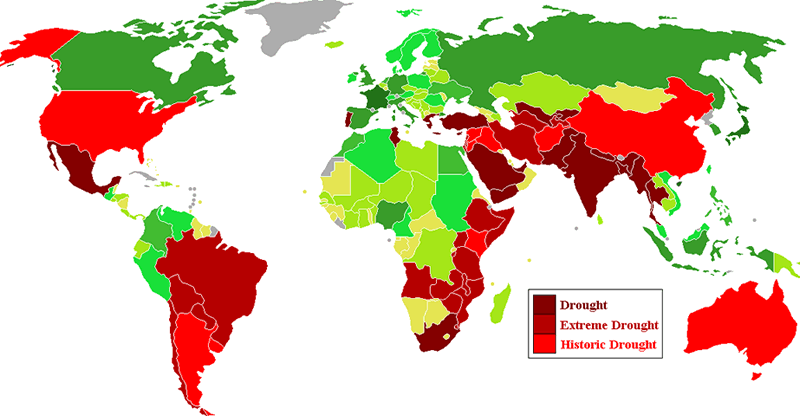 The countries that make up two thirds of the world's agricultural output are experiencing drought conditions. Whether you watch a video of the drought in China, Australia, Africa, South America, or the US , the scene will be the same: misery, ruined crop, and dying cattle.
Acid oceans 'need urgent action'
 The declaration, supported by Prince Albert II of Monaco, builds on findings from an earlier international summit.
More than 150 top marine researchers have voiced their concerns through the "Monaco Declaration", which warns that changes in acidity are accelerating.
Interior Ignored Science When Limiting Water to Grand Canyon
 Interior Department officials ignored key scientific findings when they limited water flows in the Grand Canyon to optimize generation of electric power there, risking damage to the ecology of the spectacular national landmark, according to documents obtained by The Washington Post.
A Jan. 15 memo written by Grand Canyon National Park Superintendent Steve Martin suggests that the department produced a flawed environmental assessment to defend its actions against environmentalists in court.
India's Waterways A Toxic Stew of Pharmaceutical Chemicals Dumped from Big Pharma Factories
Many of the pharmaceuticals consumed in the United States are made in India, where labor is cheap and environmental laws are lenient on powerful corporations. U.S. drug companies are exploiting this situation to manufacture hundreds of millions of doses of high-profit pharmaceuticals in India, where ingredients purchased for a few cents can be re-sold to U.S. health patients for hundreds of dollars (the markup on some drugs is literally over 500,000%).
There's something else Big Pharma doesn't want you to know about its drug operations in India: Big Pharma's manufacturing facilities dump millions of doses of toxic pharmaceutical chemicals directly into India's waterways.
Ecologists warn the planet is running short of water
A swelling global population, changing diets and mankind's expanding “water footprint” could be bringing an end to the era of cheap water.
The warnings, in an annual report by the Pacific Institute in California, come as ecologists have begun adopting the term “peak ecological water” — the point where, like the concept of “peak oil”, the world has to confront a natural limit on something once considered virtually infinite.
The world is in danger of running out of “sustainably managed water”, according to Peter Gleick, the president of the Pacific Institute and a leading authority on global freshwater resources.
More Articles...
Page 145 of 157