Environmental Glance
 More than 250 doctors across New York state wrote to Gov. Andrew Cuomo Wednesday, expressing their concern that there is no study on the long-term effects of hydraulic fracturing, or fracking, on human health included in the DEC's environmental impact statement.
"The SGEIS certainly mentions many of the toxic chemicals employed in hydraulic fracking," said Adam Law, a physician specializing in endocrinology and a clinical assistant professor of medicine at Weill-Cornell Medical College. "But there is no attempt to evaluate the kinds of health consequences that have already been observed in affected communities in those states where hydraulic fracturing is taking place."
Doctors want fracking health impact analysis
Mark Ruffalo: It's Time To Move On From Fracking And Fossil Fuels
 The debate over natural gas development and hydraulic fracturing, or fracking -- the process of injecting huge volumes of water, sand and chemicals deep underground to break up rock formations and release gas for harvesting -- appeared to enter a new phase last week.
Interior Secretary Ken Salazar hinted at the formation of new federal guidelines to govern the practice on public lands -- including rules requiring gas companies to disclose the chemicals they use for fracking.
Bill McKibben Links Tar Sands Pipeline to Corruption in Stirring Occupy Wall Street Speech (Video)
 The climate activism community is now firmly in the Occupy Wall Street (OWS) fight. 350.org joined in the tens of thousands on the streets of New York last week; and now environmental activist Bill McKibben has starkly laid out the links between climate change, the corporations blocking climate action, and the rank effect of the oil industry corrupting the Keystone XL tar sands pipeline approval process.
Saturday afternoon in Manhattan's Washington Square Park, McKibben addressed the crowd, gathered earlier in the afternoon for a special session of the Occupy Wall Street general assembly.
'Fracking' fluid pitch stirs Great Lakes pollution fears
 Clean water advocates worry that pollutants could stream into the Great Lakes if a proposal to treat chemical wastewater at a New York state sewage plant is approved.
The Niagara Falls Water Board (NFWB) is reviewing a plan to treat ‘fracking' water -- fluid waste from a gas extraction procedure -- at a facility sitting on the Niagara River, which joins up with Lake Erie and Lake Ontario.
Info Graphic shows the BIG FIVE FRACKING THREATS
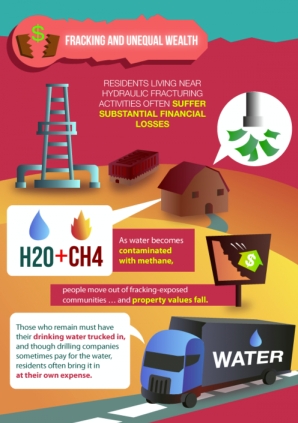 From earthquakes to poisoning drinking water this image spells out all the concerns
An info graphic posted on CleanTechnica outlines the concerns that people around the world are raising about hydraulic fracturing. Hydraulic fracturing, or fracking – as it is commonly called, is an industrial process where poisonous chemicals are mixed with water and injected into the ground at high pressures to get to natural gas supplies.
TV News Outlets Ignore Keystone XL Email Release
The environmental group Friends of the Earth released e-mails this week revealing a cozy and collaborative relationship between TransCanada Corporation lobbyist Paul Elliott and an employee at the U.S. State Department, the agency currently weighing approval of TransCanada's permit application for the controversial Keystone XL tar sands pipeline.
A New York Times report notes that the emails show the State Department official providing "subtle coaching and cheerleading" for TransCanada:
France to Keep Fracking Ban to Protect Environment, Sarkozy Says
 France will maintain a ban on fracking until there is proof that shale gas exploration won’t harm the environment or “massacre” the landscape, President Nicolas Sarkozy said.
“Development of hydrocarbon resources underground is strategic for our country but not at any price,” Sarkozy said during a visit to Ales in southern France. “This won’t be done until it has been shown that technologies used for development respect the environment, the complex nature of soil and water networks.”
More Articles...
Page 131 of 203