Science Glance
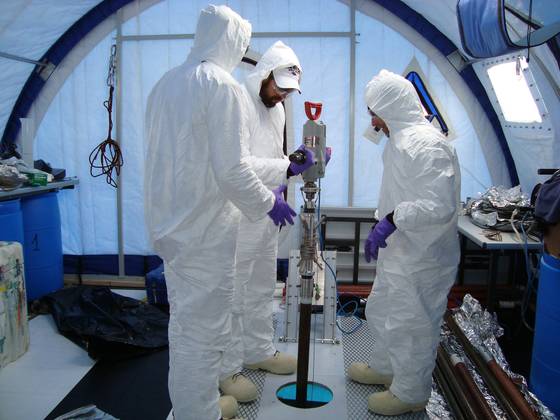 In a world without sunlight, microbes still seem to thrive in an Antarctic lake iced over for at least 2,800 years, biologists report.
Lake Vida, a chilly brine pool covered by more than 50 feet of ice, resides in East Antarctica. Biologists led by Alison Murray of the Desert Research Institute in Reno report that 2005 and 2010 core samples reveal aquatic microbes thrive in its yellowish waters, in this week's Proceedings of the National Academy of Sciences.
Antarctic microbes thrive without sunlight
Astronomers spy a planet untethered to any star; there may be many more
 There’s an orphan planet roaming our galactic neighborhood.
It’s a globe of gas about the size of Jupiter, astronomers say. And it’s out there by its lonesome, untethered to any star, drifting about 100 light-years from Earth. (In astronomical terms, that’s close.)
Astronomers have spied lonely planets before. But this newest object, seen near the southern constellation Dorado, is the closest to Earth yet found.
Brazil plans to clone endangered species
 Brazil says it will try cloning eight animal species that are under pressure, keeping them in captivity as a reserve in case wild populations collapse.
Brazil's agricultural research agency, Embrapa, working with the Brasilia Zoological Garden, has collected around 420 tissue samples, mostly from carcasses, to prepare for a cloning program, NewScientist.com reported.
Stone-age humans began using lethal technology 71,000 years ago employing spears and arrows to triumph over Neanderthals
 The date when stone-age humans first invented the lethal technology of spears and arrows has been set back many thousands of years with the discovery of small stone blades dating to 71,000 years ago.
Archaeologists believe the “bladelets” were used as the sharp tips for arrows or spears and were made by a relatively sophisticated technique involving the heat treatment of stone before shaping the final cutting edges.
Oregon scientists make embryos with 2 women, 1 man
Scientists in Oregon have created embryos with genes from one man and two women, using a provocative technique that could someday be used to prevent babies from inheriting certain rare incurable diseases.
The researchers at Oregon Health & Sciences University said they are not using the embryos to produce children, and it is not clear when or even if this technique will be put to use. But it has already stirred a debate over its risks and ethics in Britain, where scientists did similar work a few years ago.
Talking whale learns to imitate human speech in attempt to 'reach out' to human captors
 A captive white whale that made unusual mumbling sounds when he was in the presence of people may have been trying to mimic his human companions, scientists have found.
An acoustic analysis of the sounds made by a beluga whale called NOC has revealed remarkable similarities to human speech patterns, indicating that the whale was trying to “reach out” to his human captors, scientists believe.
Fighting Misinformation about Climate Science
News Corporation misleads nearly 4 million viewers and readers on climate science - Union of Concerned Scientists calls out News Corporation for overwhelmingly misleading coverage of climate science.
On September 21, 2012, the Union of Concerned Scientists hand-delivered nearly 20,000 postcards to News Corporation's New York headquarters calling on News Corp. to stop misleading its audience about climate science.
More Articles...
Page 32 of 63