War Glance
When the outgoing chairman of the Joint Chiefs of Staff, Gen. Martin Dempsey, began this month by issuing a farewell report on U.S. military strategy, the gist was hardly big news. “Dempsey to Pentagon: Prepare for the Never-Ending War” read the headline on the cover page of the National Journal.
The “war on terror” now looks so endless that no one speculates anymore about when it might conclude. “This war, like all wars, must end,” President Barack Obama declared in a major speech more than two years ago. “That’s what history advises. That’s what our democracy demands.” But midway through 2015, this war seems as interminable as ever.
Perpetual war creates endless consequences
Far from facing the truth, the US is telling new lies about Iraq
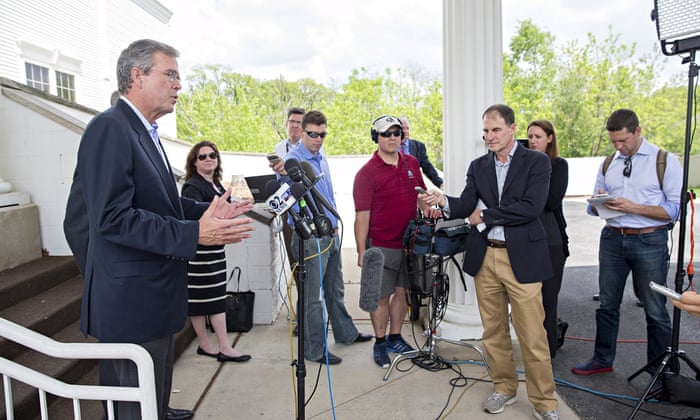 A couple of weeks ago, the Republican presidential hopeful Jeb Bush was asked in an interview with Fox News whether, knowing what he knows now, he would have invaded Iraq.
It’s the kind of predictable question for which most people assumed he would have a coherent answer. They were wrong. Jeb blew it. “I would have [authorised the invasion],” he said. “And so would have Hillary Clinton, just to remind everybody. And so would almost everybody that was confronted with the intelligence they got.”
The Real Cost of Vietnam
The commemoration of the end of the Vietnam War this week in 1975 will be lost on many Americans who are too young to recall the tumultuous events of the Indochina wars. (We also bombed Laos and Cambodia mercilessly in the same period.)
The iconic photographs of the U.S. helicopter about to lift off from the roof of the U.S. embassy in Saigon, with desperate Vietnamese scrambling to board, as the final reckoning are symbolic but also misleading. The image of the "pitiful, helpless giant" misleads because the U.S. military had almost completely withdrawn many months before after having laid waste to Vietnam, north and south, for nearly a decade.
The Terrible Legacy of Agent Orange
I wanted to put it all in the context of today’s Vietnam, forty years on. To see victims of the second and third generations, where and how they live. To learn why children and grandchildren of people affected are still being born with disabilities, to find out if people know about the dangers, and if so when did they found out.
And to take pictures of all that.
As we got closer to the former front lines travelling from the north, the number of cases increased. We kept in touch with VAVA, the main association helping victims, and they gave us much needed information, including the number of victims and where they live.
Americans have yet to grasp the horrific magnitude of the ‘war on terror’
 Even as the U.S. expands its military involvement in the Middle East and delays the troop drawdown from Afghanistan, the staggering human toll of the U.S. “war on terrorism” remains poorly understood.
A new report (PDF), whose release last month coincided with the 12th anniversary of the U.S.-led invasion of Iraq, attempts to draw attention to civilian and combatant casualties in Iraq, Afghanistan and Pakistan. Yet the study, authored by the Nobel Peace Prize laureate International Physicians for the Prevention of Nuclear War and other humanitarian groups, barely elicited a whisper in the media. Washington’s preoccupation with the rise of the Islamic State in Iraq and the Levant (ISIL) and other regional conflicts has largely obscured the humanitarian, economic and political toll of its “war on terrorism.”
Body Count Report Reveals At Least 1.3 Million Lives Lost to US-Led War on Terror
 How do you calculate the human costs of the U.S.-led War on Terror?
On the 12th anniversary of the invasion of Iraq, groups of physicians attempted to arrive at a partial answer to this question by counting the dead.
In their joint report— Body Count: Casualty Figures after 10 Years of the 'War on Terror—Physicians for Social Responsibility, Physicians for Global Survival, and the Nobel Prize-winning International Physicians for the Prevention of Nuclear War concluded that this number is staggering, with at least 1.3 million lives lost in Iraq, Afghanistan, and Pakistan alone since the onset of the war following September 11, 2001.
Afghanistan gave CIA money to al Qaeda for diplomat's ransom
About $1 million provided by the CIA to a secret Afghan government fund ended up in the hands of al Qaeda in 2010 when it was used to pay a ransom for an Afghan diplomat, the New York Times reported on Saturday.
Al Qaeda leader Osama bin Laden had at first been concerned about the payment, fearing the CIA knew about the money and had tainted it with poison, radiation or a tracking device, the Times said, and suggested it be converted to another currency.
More Articles...
Page 10 of 119