




James Goecke is a counterpoint to Kleeb. A hydrogeologist and professor emeritus at the University of Nebraska in Lincoln, he has been measuring water tables in Nebraska’s ecologically sensitive Sand Hills region since 1970 and has shunned the political limelight — until now. He recently appeared in an ad for the pipeline’s owner, TransCanada, rebutting some of the arguments against the project and its new route.
Keystone XL pipeline may threaten aquifer that irrigates much of the central U.S.
The Bombs of August : In Remembrance of Hiroshima and Nagasaki

The crew of the B-29 was so young and heroic, and in the photo they also looked very happy. For some reason, I clearly remember the name of the pilot, Paul Tibbets. Of course I remember the name of the plane, the Enola Gay. And oh yes, I remember the name of the bomb. It was called Little Boy. That made me smile.
Roswell UFO Crash: There Were 2 Crashes, Not 1, Says Ex-Air Force Official
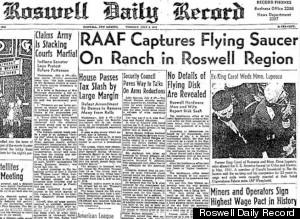 The 1947 UFO controversy of Roswell, N.M. is like a bad penny: It keeps turning up. The legend, rehashed by conspiracy theorists in countless documentaries, revolves around allegations that an unusual object fell from the sky -- an object so bizarre that the U.S. Air Force issued a press release that a flying saucer had crashed.
That story was quickly recanted, creating what would become one of the greatest urban legends in American history.
Alex Baer: All This Underwear, All These Twists

There was the usual chit-chat first -- checking the temp on club members' relationships, jabbering a drizzle of baseball, tallying injuries from any DIY jobs, and finding out where everyone else's job search was pegged for the week on the Barf-O-Meter.
The CIA: An Agency That Should Have Never Been
 Steve Coll ends his important book on Afghanistan by quoting Afghan President Hamid Karzai: “What an unlucky country.” Americans might find this a convenient way to ignore what their government did in Afghanistan between 1979 and the present, but luck had nothing to do with it. Brutal, incompetent, secret operations of the U.S. Central Intelligence Agency, frequently manipulated by the military intelligence agencies of Pakistan and Saudi Arabia, caused the catastrophic devastation of this poor country. On the evidence contained in Coll’s book Ghost Wars, neither the Americans nor their victims in numerous Muslim and Third World countries will ever know peace until the Central Intelligence Agency has been abolished.
Assassination Nation: From the Phoenix Program to Predator Drones
 This spring the US drone killing program has come out of the closet. Attorney General Eric Holder publicly defended the drone killing of an American citizen [2], while Obama’s counter terrorism czar John Brennan publicly explained and justified the target killing program [3]. And a New York Times article by Jo Becker and Scott Shane chronicled Obama’s personal role in vetting a secret “Kill List.” [4]
This striking new transparency, the official acknowledgment for the first time of a broad-based US assassination and targeted killing program, has resulted from the unprecedented and controversial visibility of drone warfare.
Drones now make news every day, and those of us who have been protesting their use for years have heightened their visibility in the public eye, forcing official acknowledgment and fostering worldwide scrutiny. This new scrutiny focuses not only on drone use but also, and perhaps more importantly, on the targeted killing itself – and the “kill lists” that make them possible.
NASA scientist ties heat waves to global warming
Twenty-four summers ago, NASA scientist James Hansen first warned the world about what he called the dangers of global warming. In front of a Senate panel, he said he was "99% certain" that a recent warming trend was not a natural variation but caused by a buildup of carbon dioxide and other gases in the atmosphere from burning fossil fuels.
Now, a study released this weekend by Hansen, the dean of climate scientists, concludes that the recent heat waves and extreme summers likely were caused by climate change.
Israel’s Fading Democracy
 When an American presidential candidate visits Israel and his key message is to encourage us to pursue a misguided war with Iran, declaring it “a solemn duty and a moral imperative” for America to stand with our warmongering prime minister, we know that something profound and basic has changed in the relationship between Israel and the United States.
My generation, born in the ’50s, grew up with the deep, almost religious belief that the two countries shared basic values and principles. Back then, Americans and Israelis talked about democracy, human rights, respect for other nations and human solidarity. It was an age of dreamers and builders who sought to create a new world, one without prejudice, racism or discrimination.
Lambs to the settlers' slaughter, screaming and unheard
 There were more than 50 reports of Israelis assaulting Palestinians in the West Bank last month. In the start of a regular series, Haaretz details one particularly violent attack
There is still a bruise under Ibrahim Bani Jaber's left eye. The blows his brother Jawdat received to his right ear didn't leave any marks, but they still make his head feel heavy. During our meeting at their home in the West Bank village of Akraba last week, they did not spend much time describing the fear and pain they felt when they were attacked. Instead, they spoke about the family's sheep, that they had rushed to try and save that day, July 7, when they heard that settlers were attacking them.
Page 451 of 1167