Environmental Glance
President Barack Obama’s nominee for energy secretary is drawing criticism for leading a study that minimized risks of natural gas while failing to disclose that some of its researchers had financial ties to the industry.
The nominee, Ernest Moniz, who now is the head of the Massachusetts Institute of Technology’s Energy Institute, came out with its report in 2011 that said the environmental risks of increased drilling and production “are challenging but manageable.”
Obama Energy Nominee’s MIT Fracking Study Faulted Over Industry Ties
Drought that ravaged US crops likely to worsen in 2013, forecast warns
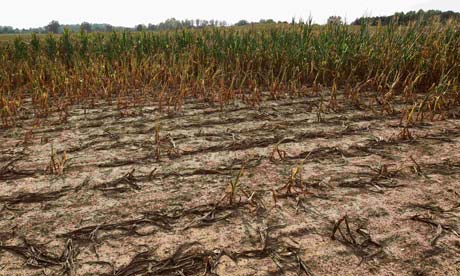 The historic drought that laid waste to America's grain and corn belt is unlikely to ease before the middle of this year, a government forecast warned on Thursday.
The annual spring outlook from the National Oceanic and Atmospheric Administration predicted hotter, drier conditions across much of the US, including parts of Texas, Oklahoma and Kansas, where farmers have been fighting to hang on to crops of winter wheat.
Fracking, PR, and the Greening of Gas
 In establishing natural gas and fracking as the clean alternative to coal and the “bridge” to a low-carbon future, the natural gas industry has relied on PR to smooth its way. While the most visible anti-fracking campaigns remain regional and local, tied to the politics of exploding water and poisoned wells, gas companies and lobbyists are moving to globalize the debate. Their message: rational environmentalists should embrace gas, because gas will save us from climate change.
That message was stimulated by 99 words in a 492-word press release from the International Energy Agency (IEA). Though it was contradicted in the same week by an IEA spokesperson and a much longer IEA report, the message spread — from the conservative press and gas lobbyists to the halls of government. Now, it’s simply taken as fact.
EPA reverses water pollution decision after lobbyist steps in
 When Uranium Energy Corp. sought permission to launch a large-scale mining project in Goliad County, Texas, it seemed as if the Environmental Protection Agency would stand in its way.
To get the ore out of the ground, the company needed a permit to pollute a pristine supply of underground drinking water in an area already parched by drought.
Further, EPA scientists feared that radioactive contaminants would flow from the mining site into water wells used by nearby homes. Uranium Energy said the pollution would remain contained, but resisted doing the advanced scientific testing and modeling the government asked for to prove it.
Palms, Matzah, Our Planet, and the White House: A Religious Call to Civil Disobedience
 At noon on March 21, religiously and spiritually rooted Americans of all traditions will gather at the White House for a moral act of loving nonviolent civil disobedience.
This action, organized by the Interfaith Moral Action on Climate (IMAC) and strongly supported by The Shalom Center, will make clear to President Obama that his inspired pledge to halt the destruction of the Earth from climate change requires that he take bold and courageous actions, including rejecting the Keystone XL tar sands pipeline.
Large rise in CO2 emissions sounds climate change alarm
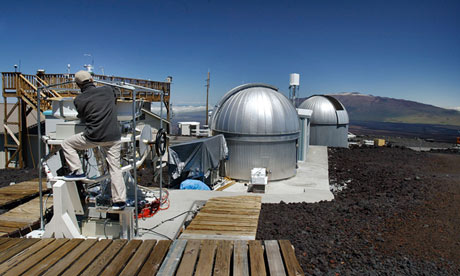 The chances of the world holding temperature rises to 2C – the level of global warming considered "safe" by scientists – appear to be fading fast with US scientists reporting the second-greatest annual rise in CO2 emissions in 2012.
Carbon dioxide levels measured at at Mauna Loa observatory in Hawaii jumped by 2.67 parts per million (ppm) in 2012 to 395ppm, said Pieter Tans, who leads the greenhouse gas measurement team for the US National Oceanic and Atmospheric Administration (NOAA). The record was an increase of 2.93ppm in 1998.
Global temperature rise is fastest in at least 11,000 years, study says
Over the past century, global average temperatures appear to have risen faster than at any time since the end of the last ice age 11,300 years ago, and perhaps longer. Meanwhile, the magnitude of the increase has been unmatched in at least the past 4,000 years.
Researchers say those are the implications of a new study that uses natural stand-ins for thermometers to trace temperature trends back to the beginning of the current warm, interglacial period. Significantly, the study’s findings suggest the current warming trend cannot be explained by naturally occurring temperature variability, a lingering issue in the debate over the impact of human activity on global warming.
More Articles...
Page 76 of 203