Human Rights Glance
"In the immediate aftermath of 9/11 we did some things that were wrong. We did a whole lot of things that were right, but we tortured some folks."
It's been more than a year since US President Barack Obama admitted that the CIA tortured prisoners at its interrogation centres.
While the CIA has long admitted the use of waterboarding, which simulates drowning by pouring water into a person's nose and mouth, a truncated and heavily redacted report by the Senate Intelligence Committee in December 2015 detailed other abuses that went beyond previous disclosures.
The Dark Prison: Legacy of the CIA Torture Program
Palestinian journalist ends hunger strike
 A Palestinian activist and journalist has ended his three-month hunger strike and will be released in three months.
The family of Mohammad al-Qeeq, who worked for a Saudi media outlet, announced on Friday that he was ending his fast.
Fayha, Qeeq's wife, described the announcement as "a very big victory for us and for him".
Under a deal with Israel, he will remain in custody until May 21, but his so-called administrative detention will not be renewed after that.
Palestinian detainee on hunger strike reaches 89 days
 A Palestinian detainee has entered uncharted medical territory with a hunger strike of 89 days — longer than protest fasts by other Palestinians or by prisoners in Northern Ireland in 1981, an advocacy group said Monday.
Mohammed Al-Qeq, a news reporter for Saudi channel Al Majd, is under observation at an Israeli hospital, but has refused all treatment unless he is released from Israeli custody.
A doctor who visited him earlier this month described his condition as "extremely grave" and said Qeq, 33, could barely speak or even hear.
Israel's unwanted African migrants
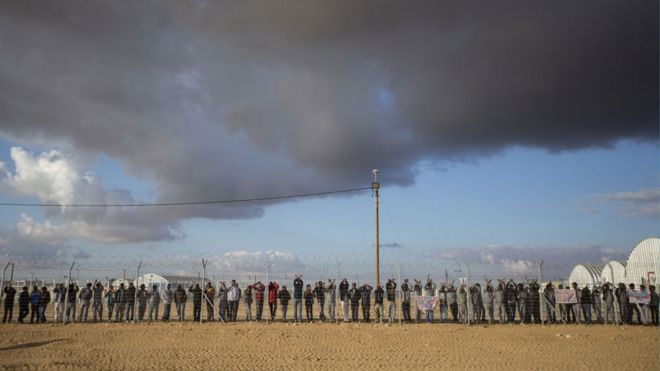 For nearly a year Israel has been offering African migrants cash and the chance to go and live in what is supposed to be a safe haven in a third country - but the BBC has spoken to two men who say that they were abandoned as soon as they got off the plane. One was immediately trafficked, the other left to fend for himself without papers.
Adam was 18 when he arrived in Israel in 2011. Attackers had burned down his home in Darfur at the height of the genocide, and he had spent his teenage years in a UN refugee camp in another part of Sudan. With no prospects in the camp and no sign of an end to the conflict in Darfur, he made his way north through Egypt and the lawless Sinai peninsula to Israel.
ISIS Documents Set Sexual Slavery Rules
 Islamic State theologians have issued an extremely detailed ruling on when "owners" of women enslaved by the extremist group can have sex with them, in an apparent bid to curb what they called violations in the treatment of captured females.
The ruling or fatwa has the force of law and appears to go beyond the Islamic State's previous known utterances on the subject, a leading Islamic State scholar said. It sheds new light on how the group is trying to reinterpret centuries-old teachings to justify the sexual slavery of women in the swaths of Syria and Iraq it controls.
Israeli PM condemns video of Jewish extremists celebrating toddler's death
 Senior Israeli politicians and religious figures have condemned an incendiary video showing a hall packed full of Jewish extremist teenagers cheering the death of a Palestinian toddler murdered in an anti-Palestinian hate crime earlier this year.
The video – which shows the teenagers dancing with guns and firebombs and stabbing a picture of Ali Dawabshe, who died with his parents in an arson attack on their home this summer – was filmed at a wedding three weeks ago and obtained by an Israeli television channel. The Israeli prime minister, Binyamin Netanyahu, immediately condemned its “shocking images”, which he said displayed “the real face of a group that poses danger to Israeli society and security”.
Carter to release some detainee abuse photos, but withholds majority
Defense Secretary Ash Carter has moved to block the release of about 2,000 photos of detainees allegedly abused in U.S. military custody in Iraq and Afghanistan, but he parted with his predecessors by agreeing to release about 200 such photos that have been under wraps for years, according to a new court filing.
Carter signed a certification last month invoking his authority under a 2009 law to refuse disclosure of the photos under the Freedom of Information Act. The legal provision was passed after President Barack Obama, who initially acquiesced to release of the images, did an about-face and called on Congress to pass legislation to keep them secret.
More Articles...
- Group: Israel used 'excessive' force against Palestinians
- Torture by Iraqi militias: the report Washington did not want you to see
- How a group of 22 men from China's Uighur community were sold in Afghanistan and imprisoned in Gitmo as terrorists.
- Gitmo detainee held for 13 years is victim of mistaken identity, says US
Page 26 of 199