


 Scientists have discovered more about the role of an important brain protein which is instrumental in translating learning into long-term memories.
Writing in Nature Neuroscience, they said further research into the Arc protein's role could help in finding new ways to fight neurological diseases.
The same protein may also be a factor in autism, the study said. Recent research found Arc lacking in the brains of Alzheimer's patients.
Arc protein 'could be key to memory loss', says study
How Google and Silicon Valley Screw Their Non-Elite Workers
 Silicon Valley sparks the imagination. Its wealth of tech jobs, flashy startups and new media goliaths seems to point toward a better future, beyond post-industrial doldrums and slack labor markets. Work on Google’s idyllic Mountain View campus hardly looks like work at all.
But some Google employees are less equal than others. (Not everyone gets to ride the clown bikes.) Many of Silicon Valley’s blue-collar jobs are outsourced to subcontractors, a practice common with Google, Apple, Hewlett-Packard, and other big tech firms. Usually the lowest bidder gets the contract, and in labor intensive industries such as security, food service, janitorial and landscaping the lower bids tend to come from firms with lower labor standards.
Ex-CIA worker is behind NSA leak
 Edward Snowden, a 29-year-old former undercover CIA employee, unmasked himself Sunday as the principal source of recent Washington Post and Guardian disclosures about top-secret National Security Agency programs.
Snowden, who has contracted for the NSA and works for the consulting firm Booz Allen Hamilton, denounced what he described as systematic surveillance of innocent citizens and said in an interview that “it’s important to send a message to government that people will not be intimidated.”
US management of wild horses flawed, scientific report finds
A federal agency working to rein in the population of wild horses in the West should rely more on fertility control than roundups because it would be more effective, a National Academy of Sciences review said on Wednesday.
The critique of the U.S. Bureau of Land Management's (BLM) handling of 37,300 free-ranging horses and burros also faulted the agency for a lack of transparency and public involvement in key decisions about the federally protected animals.
Tens of thousands evacuated due to floods in Germany and Hungary
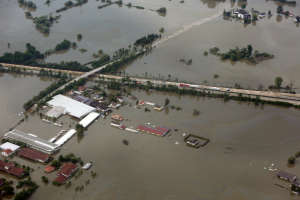
Heavy rains across the region during the past week, combined with a wet spring, prompted the flooding and swelling of the Elbe and Danube rivers. High waters have receded in parts of Austria and the Czech Republic, but the swollen rivers are inundating Germany and Hungary downstream.
Air polluters like to send their emissions across state lines
 If you near a state line, you might be getting an unusually heavy dose of pollution from your neighbors across the border.
That’s the conclusion of a working paper by political scientists James Monogan, David Konisky and Neal Woods. They report that air polluting facilities in the United States are disproportionately likely to be located near downwind borders. When the breeze picks up, noxious emissions are hustled out of state and become someone else’s problem.
Inside the Global Industry That's Slaughtering Africa's Elephants
 Destruction and Death, as Pope Francis offered this homily in St. Peter's Square, had just left the scene in the central African nation of Chad, where in a single night in mid-March 89 elephants were slaughtered for their tusks.
Reports described the ivory poachers as 50 or so men on camel and horseback, speaking Arabic, armed with AK-47s, and presumed to be the same band that came over from Sudan last year to execute more than 450 elephants in Cameroon -- on that foray, dispatching their victims with rocket-propelled grenades.
9/11 family members demand the FBI ‘come clean’ about Sarasota Saudis
A group representing 6,600 survivors and relatives of those killed and injured in the 9/11 attacks has called on the FBI to “come clean” about its investigation of Saudis in Florida who may have aided the terrorist hijackers.
The reaction by 9/11 Families United to Bankrupt Terrorism on Thursday followed news that former U.S. Sen. Bob Graham had accused the FBI in court papers of concealing the existence of its Sarasota investigation and impeding Congress’s Joint Inquiry into the Sept. 11, 2001, attacks.
What We Don't Know About Spying on Citizens: Scarier Than What We Know
 Yesterday, we learned that the NSA received all calling records from Verizon customers for a three-month period starting in April. That's everything except the voice content: who called who, where they were, how long the call lasted -- for millions of people, both Americans and foreigners.
This "metadata" allows the government to track the movements of everyone during that period, and a build a detailed picture of who talks to whom. It's exactly the same data the Justice Department collected about AP journalists.
Page 377 of 1185