Environmental Glance
A new documentary produced and starring actor and activist Leonardo DiCaprio premieres in Los Angeles today and will be broadcast globally in 45 languages in 171 countries on the National Geographic Channel starting Oct. 30, timed to air in advance of the November elections.
The film highlights the critical role forest destruction plays in driving carbon pollution into Earth's atmosphere and focuses specifically on how the rapid spread of industrial palm oil plantations in Southeast Asia are at the heart of this crisis. The film It is directed by Fisher Stevens who, like DiCaprio, is an Academy Award winner.
DiCaprio's Climate Doc Exposes Destruction of Rainforest for Palm Oil as Huge Driver of Global Carbon Emissions
The Great Pacific Garbage Patch Is Even Worse Than We Feared
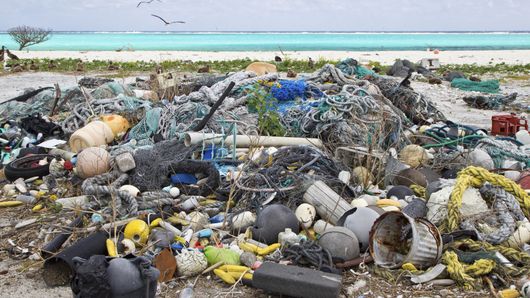 The first aerial survey of the Great Pacific Garbage Patch shows that the amount of debris swirling in the North Pacific has been “heavily underestimated,” the expedition group said.
On Monday, The Ocean Cleanup, a project founded in 2013 by then-18-year-old Dutch inventor Boyan Slat with the goal of ridding the world’s oceans of plastic, shared initial findings from its aerial expedition of the trash vortex between Hawaii and California.
Category 4 Matthew heads for Bahamas and South Florida; hurricane watch issued
 "Extremely dangerous" Category 4 Hurricane Matthew is moving north toward Cuba, the Bahamas and Florida, where the National Hurricane Center has issued a hurricane watch for much of the state's Atlantic coast.
Matthew made landfall near Les Anglais in western Haiti at 7 a.m. Tuesday with 145 mph winds and torrential rains. The National Hurricane Center says Matthew strengthened afterward with 150 mph winds with gusts up to 175 mph late Tuesday morning, making it the most powerful Atlantic storm since 2007.
Texas activists who lost one pipeline fight set sights on ne

It looks to Lori Glover “like a long snake going across the whole desert”. For David Keller, it is “like having a very beautiful historic home and having someone run a bulldozer through the kitchen”. And in Yolonda Blue Horse’s view, it is another example of disrespect from an industry that does not care about native people.
Before the Dakota Access pipeline sparked continuing protests that led to national attention and an Obama administration intervention, a feisty group of activists in remote west Texas waged a long battle against the same company when it pressed ahead with plans to run a 143-mile natural gas pipeline to Mexico through some of the state’s most pristine countryside.
NASA: Earth Warming at a Pace ‘Unprecedented in 1,000 Years’
 The planet is warming at a pace not experienced within the past 1,000 years, at least, making it “very unlikely” that the world will stay within a crucial temperature limit agreed by nations just last year, according to Nasa’s top climate scientist.
This year has already seen scorching heat around the world, with the average global temperature peaking at 1.38C above levels experienced in the 19th century, perilously close to the 1.5C limit agreed in the landmark Paris climate accord. July was the warmest month since modern record keeping began in 1880, with each month since October 2015 setting a new high mark for heat.
Fracking Update: 3 tremors in 24 hours near Oklahoma shale country
Three minor seismic events were recorded near the shale reserve areas in Oklahoma in the past 24 hours, data for the U.S. Geological Survey show.
USGS data show the strongest of the three seismic events was a magnitude-2.9 tremor recorded shortly after midnight in southern Kansas, a few miles from the state border with Oklahoma. A magnitude-2.5 event was recorded in Fairview, Okla., early Sunday afternoon.
Fracking wells may increase asthma attacks, study says
 Ever wondered if your asthma attacks can be tied to the fracking wells near your house? You are probably right.
Asthma patients are 1.5 to four times more likely to have asthma attacks if they live near bigger or a larger number of unconventional natural gas development wells, according to a study published Monday in the Journal of the American Medical Association Internal Medicine.
More Articles...
Page 19 of 202