Science Glance
 UK researchers have demonstrated the highest-resolution optical microscope ever - aided by tiny glass beads. The microscope imaged objects down to just 50 billionths of a metre to yield a never-before-seen, direct glimpse into the "nanoscopic" world.
The team says the method could even be used to view individual viruses. Their technique, reported in Nature Communications, makes use of "evanescent waves", emitted very near an object and usually lost altogether.
Microscope with 50-nanometre resolution demonstrated
We're all aliens... how humans began life in outer space
 As scientific mysteries go, this is the big one. How did life on Earth begin? Not how did life evolve, but how did it start in the first place? What was the initial spark that lit the fire of evolution?
Charles Darwin solved the mystery of life's wondrous diversity with his theory of natural selection. But even he was flummoxed by the ultimate mystery of mysteries: what led to the origin of life itself?
Earliest human remains in US Arctic reported
 Some 11,500 years ago one of America's earliest families laid the remains of a 3-year-old child to rest in their home in what is now Alaska. The discovery of that burial is shedding new light on the life and times of the early settlers who crossed from Asia to the New World, researchers report in Friday's edition of the journal Science.
The bones represent the earliest human remains discovered in the Arctic of North America, a "pretty significant find," said Ben A. Potter of the University of Alaska Fairbanks.
Dark Matter, Bright Stars: New Evidence on How Galaxies Are Born
 Decades ago, a few astronomers began to suspect that the universe was swarming with some mysterious, invisible substance that was yanking galaxies around with its own powerful gravity. And for those same decades, most of those astronomers' colleagues dismissed the notion as pretty much nuts.
But the evidence kept mounting, and nowadays dark matter is a firmly established concept in modern astrophysics. It pretty much has to exist, in fact, to explain why individual galaxies spin as fast as they do without flying apart, and why groups of galaxies move the way they do in relation to one another.
Scientists build the world's first anti-laser
 Physicists have built the world's first device that can cancel out a laser beam - a so-called anti-laser. The device, created by a team from Yale University, is capable of absorbing an incoming laser beam entirely.
But this is not intended as a defence against high-power laser weapons, the researchers said. Instead they think it could be used in next-generation supercomputers which will be built with components that use light rather than electrons.
NASA Images the Entire Sun, Far Side and All
 It might not seem obvious why anyone should care what's happening on the other side of the Sun. But NASA can explain: our home star is a seething, roiling ball of superhot gas that goes through cycles of relative quiet, punctuated by violent outbursts. Every so often, the Sun spits out a blob of charged subatomic particles — and occasionally, one of them is aimed directly at the Earth.
These eruptions, known as coronal mass ejections, aren't enough to hurt the planet physically; they're very hot, but also very insubstantial. What they can do is fry the electronics of communications satellites, and even put astronauts in danger of a radiation overdose.
Nasa scientists discover planetary system
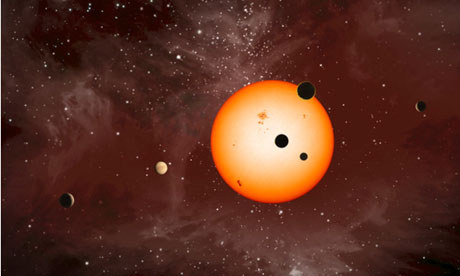 Astronomers have discovered a planetary system made up of six planets orbiting a Sun-like star that is more than 2,000 light years from Earth. It is the largest number of planets found so far around a single star. More than 100 planets have been seen outside our solar system, but most are Jupiter-like gas giants, and almost all are in single-planet systems.
Jack Lissauer, a scientist at Nasa's Ames research centre in California and a lead author on a paper published tomorrow in the journal Nature, said that the Kepler-11 finding was "the biggest thing in exoplanets since the discovery of 51 Pegasi B, the first exoplanet, back in 1995".
More Articles...
Page 43 of 62